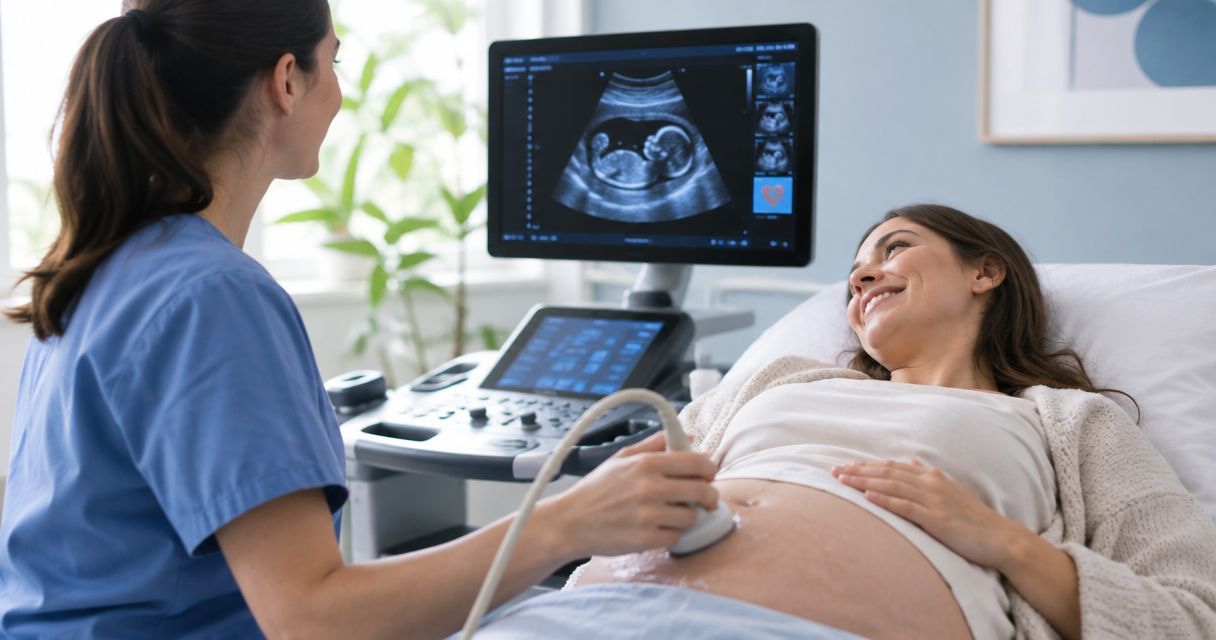

Coordinating an ultrasound around your midwife's prenatal visit calendar doesn't need a spreadsheet — it needs a fixed sequence built on gestational weeks, not guesswork. Instead of scheduling scans reactively and showing up to a prenatal visit with no report to discuss, build the ultrasound calendar first and set your midwife visits around the results.
- Ultrasound scheduling for home birth midwife care runs on three fixed windows: 6-9, 18-22, and 28-32 weeks.
- Texas home birth midwives don't carry ultrasound equipment, so a self-referred scan at The Ultrasound Concierge fills the gap.
- Book each scan 5-7 days before the matching midwife visit so the report is in hand, not pending.
- Twin or high-risk pregnancies need scans roughly every 4 weeks after 28 weeks — flag this with your midwife before you book.
Why this matters
Most licensed home birth midwives in Texas are certified professional midwives, not physicians, and they don't have ultrasound machines in their practice. That means every scan in your pregnancy — dating, anatomy, growth, position check — happens somewhere else, on a separate calendar, with a separate provider.
When that second calendar isn't synced to your midwife's visit rhythm, you end up rescheduling one appointment to accommodate the other, or worse, sitting through a prenatal visit with no current imaging to talk through. The fix is sequencing, not more appointments. In-home ultrasound services near Fort Worth exist specifically to slot into a home birth timeline without the wait times of a hospital imaging department, and in 2026 most midwifery practices expect patients to bring their own report rather than wait on a referral to process.
Before you start
- Your midwife's visit calendar — either actual dates or the cadence she follows (monthly through 28 weeks, biweekly 28-36, weekly after 36 is standard for most CPM practices).
- Your estimated due date or last menstrual period, so scan windows can be calculated in weeks, not calendar months.
- A delivery method for the report — PDF export, patient portal upload, or a printed copy your midwife's practice can file, since not every home birth practice accepts digital-only records.
- The gotcha: book a scan too close to a prenatal visit and you'll show up with "results pending" instead of an actual report. Most midwives want the imaging in hand at the visit, not promised for later — build in a buffer of at least 5-7 days.
Map your midwife's visit calendar to ultrasound windows
- List out your midwife's visit dates (or projected dates based on her cadence) from intake through 36+ weeks.
- Overlay the four standard scan windows against those dates using gestational age, not the calendar month.
- Flag which visit each scan should land before — this becomes your booking deadline for each appointment.
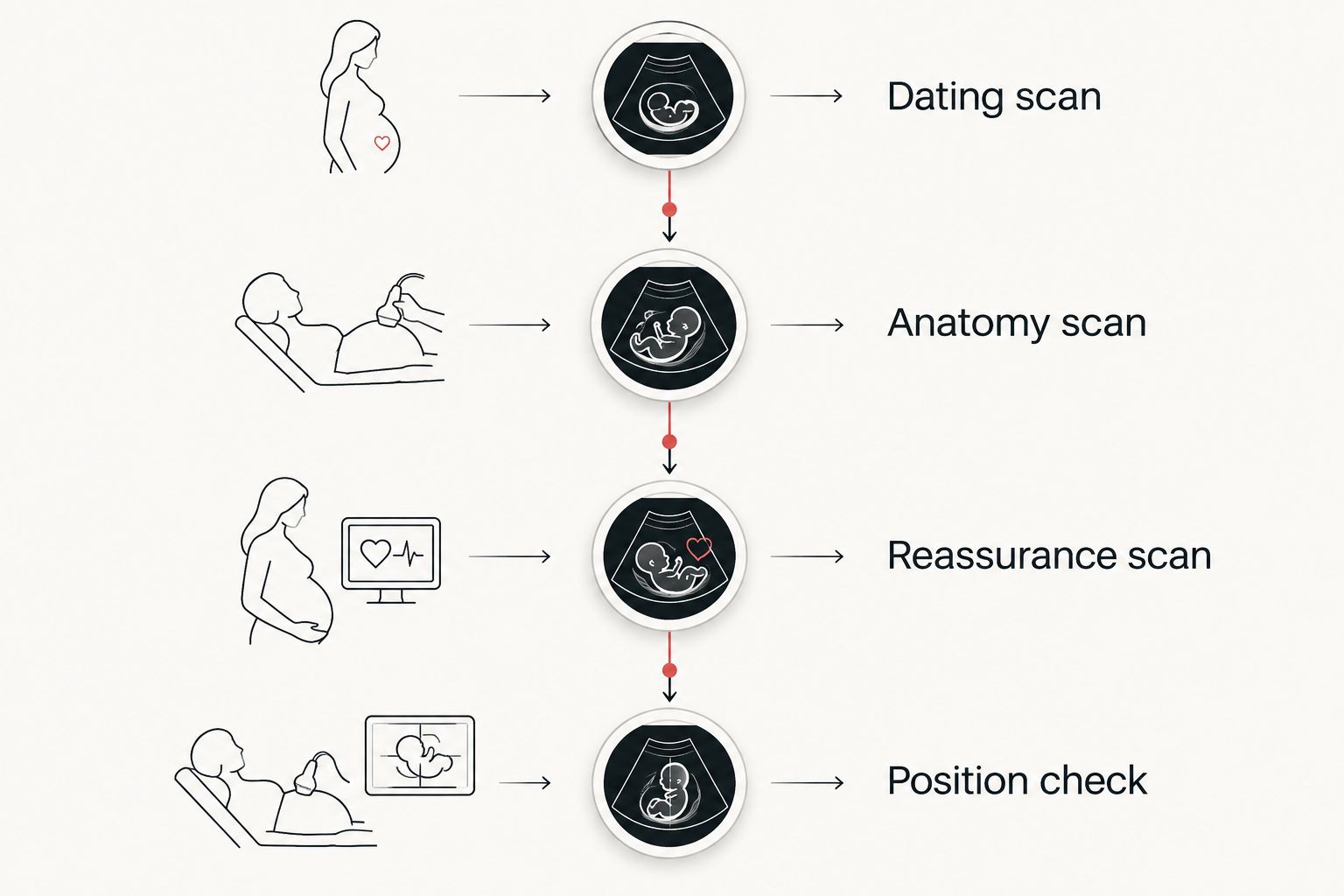
| Scan | Typical window | What it confirms | Sync it with |
|---|---|---|---|
| Dating/viability scan | 6-9 weeks | Due date, heartbeat, single vs. multiples | Midwife's intake visit |
| Anatomy scan | 18-22 weeks | Organ development, placenta position, sex if desired | First monthly visit past 18 weeks |
| Reassurance/growth scan | 28-32 weeks | Growth trajectory, fluid level, positioning | Start of the biweekly visit phase |
| Late position check | 36+ weeks | Head-down positioning, placenta clearance | Weekly visit phase |
Expected result: four scan dates on your calendar, each falling 5-7 days ahead of the midwife visit it feeds into.
Book the anatomy scan around your mid-pregnancy visit
- Confirm your gestational age at the time of your next monthly visit past 18 weeks.
- Book the anatomy scan for a date that falls 5-7 days before that visit — this gives you time to review the report and bring questions.
- Request that the report include placenta location and amniotic fluid notes, since most midwives ask for both at this stage.
- Forward or hand-carry the finished report to your midwife ahead of or at the visit.
Expected result: your midwife opens the mid-pregnancy visit with the anatomy report already in front of her instead of asking whether it's scheduled.
Schedule third-trimester reassurance or growth scans
- Identify the first biweekly visit after 28 weeks on your midwife's calendar.
- Book the reassurance or growth scan 5-7 days ahead of that visit, matching the window in the table above.
- If your midwife has flagged a specific concern — low fluid, breech positioning, slowed growth — note it when you book so the sonographer knows what to look for.
- Repeat the scan every 4 weeks if your midwife's plan of care calls for ongoing monitoring through the biweekly and weekly phases.
“If your midwife doesn't have a report in hand at your 32-week visit, you're rescheduling both appointments.”
Send results to your midwife before the next visit
- Ask for the report in the format your midwife's practice accepts — most take a PDF by email or a printed copy at the visit.
- Confirm turnaround time when you book so you're not waiting on a fax the morning of your appointment.
- Keep a personal copy in your own records folder — home birth charts sometimes move between providers if your care plan changes mid-pregnancy.
Expected result: your midwife reviews the same report you have, before or during the visit, with no gap between the scan date and the discussion of it.
Scheduling around a late position check or breech concern
This is the second workflow worth building into your calendar: a position check scan booked specifically for 36+ weeks when your midwife needs to confirm head-down positioning before clearing you for home birth. Book this one 3-5 days ahead of the weekly visit where the decision gets made, tighter than the earlier windows because there's less runway left in the pregnancy. If positioning is still unclear, most midwives will ask for a repeat scan within a week rather than wait for the next scheduled visit — build that flexibility into your calendar rather than treating the four-scan sequence as fixed.
Troubleshooting
- Your midwife's practice doesn't accept digital-only reports. Ask for a printed copy at booking — most private ultrasound providers can produce one on the spot.
- The scan date and the visit date collide. Move the scan earlier, never the visit later — midwives run tight prenatal calendars and rescheduling a visit costs you more time than rebooking a scan.
- Your midwife flags a concern between scheduled scans. Book a one-off scan rather than waiting for the next window on the table above; reassurance ultrasound windows are guidelines, not a hard rule when something specific needs checking.
- Insurance doesn't cover a self-referred scan. Confirm your payment method before booking — FSA or HSA cards often cover elective and diagnostic imaging even without a physician referral.
- Twin or high-risk pregnancies outgrow the standard four-scan calendar. Expect a scan roughly every 4 weeks after 28 weeks instead of the single reassurance scan — tell your midwife before you book so the cadence gets built into her visit schedule too.
Customize your scheduling workflow
The four-scan calendar above covers a straightforward singleton pregnancy. If you're working with a doula alongside your midwife, the same scheduling logic applies to her visit rhythm — see the guide on ultrasound referrals for doulas for how that calendar layers on top. Texas doesn't require a physician referral for an elective or diagnostic ultrasound, which is the detail that makes this whole workflow possible for home birth families in the first place — self-referral is the norm, not the exception, as of 2026.
Book your next scan around your midwife visit
Private, unhurried imaging scheduled to fit your prenatal calendar.
FAQ
Can a home birth midwife order my ultrasound in Texas?
A Texas midwife can recommend a scan, but she typically doesn't need to formally order it since elective and diagnostic ultrasounds don't require a physician referral in 2026. Most home birth patients self-refer directly to a private imaging provider.
When should I schedule my anatomy scan around my midwife visits?
Book the anatomy scan 5-7 days before your first monthly prenatal visit past 18 weeks. That gives the report time to be ready when your midwife reviews it.
How soon before a prenatal visit should I book an ultrasound?
Aim for 5-7 days ahead of the visit for the anatomy and reassurance scans, and 3-5 days ahead for a late-pregnancy position check since there's less runway left before delivery decisions get made.
Do I need a doctor's referral for an elective ultrasound in Texas?
No. Texas does not require a physician referral for elective or diagnostic ultrasound imaging, which is why self-referral is standard practice for home birth patients in 2026.
What happens if my midwife needs a growth scan I haven't scheduled yet?
Book a one-off scan outside the standard four-window calendar rather than waiting for the next scheduled slot. Reassurance and growth scans get moved up whenever a specific concern comes up mid-pregnancy.
How many ultrasounds does a typical home birth pregnancy need?
Most singleton home birth pregnancies follow four scans: dating (6-9 weeks), anatomy (18-22 weeks), reassurance or growth (28-32 weeks), and a late position check (36+ weeks).
Can twin pregnancies use the same scheduling rhythm?
No. Twin pregnancies generally need a scan roughly every 4 weeks starting around 28 weeks instead of a single reassurance scan, so the visit calendar needs a tighter overlay.
Is a home birth ultrasound different from a hospital ultrasound?
The imaging itself follows the same clinical windows, but a private setting like The Ultrasound Concierge schedules around your prenatal calendar directly instead of routing you through a hospital imaging department's own booking system.
One last thing
The detail most home birth families miss isn't which scan to book — it's that the report format matters as much as the timing. A practice that files paper charts won't take a portal link, and a midwife using digital charting may ask you to stop bringing printouts altogether. Ask once, early in pregnancy, and the whole four-scan calendar runs without a single rescheduled visit through 2026.