
A reassurance ultrasound for high-risk pregnancy is an elective scan booked between scheduled OB or maternal-fetal medicine (MFM) visits to confirm fetal heartbeat, movement, growth, or position when a known risk factor makes the wait between appointments feel too long. High-risk patients — those managing gestational diabetes, a prior loss, twins, preeclampsia, or advanced maternal age — need a different scan cadence and a different set of questions answered than a routine pregnancy does.
- A reassurance ultrasound for high-risk pregnancy fills the gap between OB or MFM visits, not replaces them.
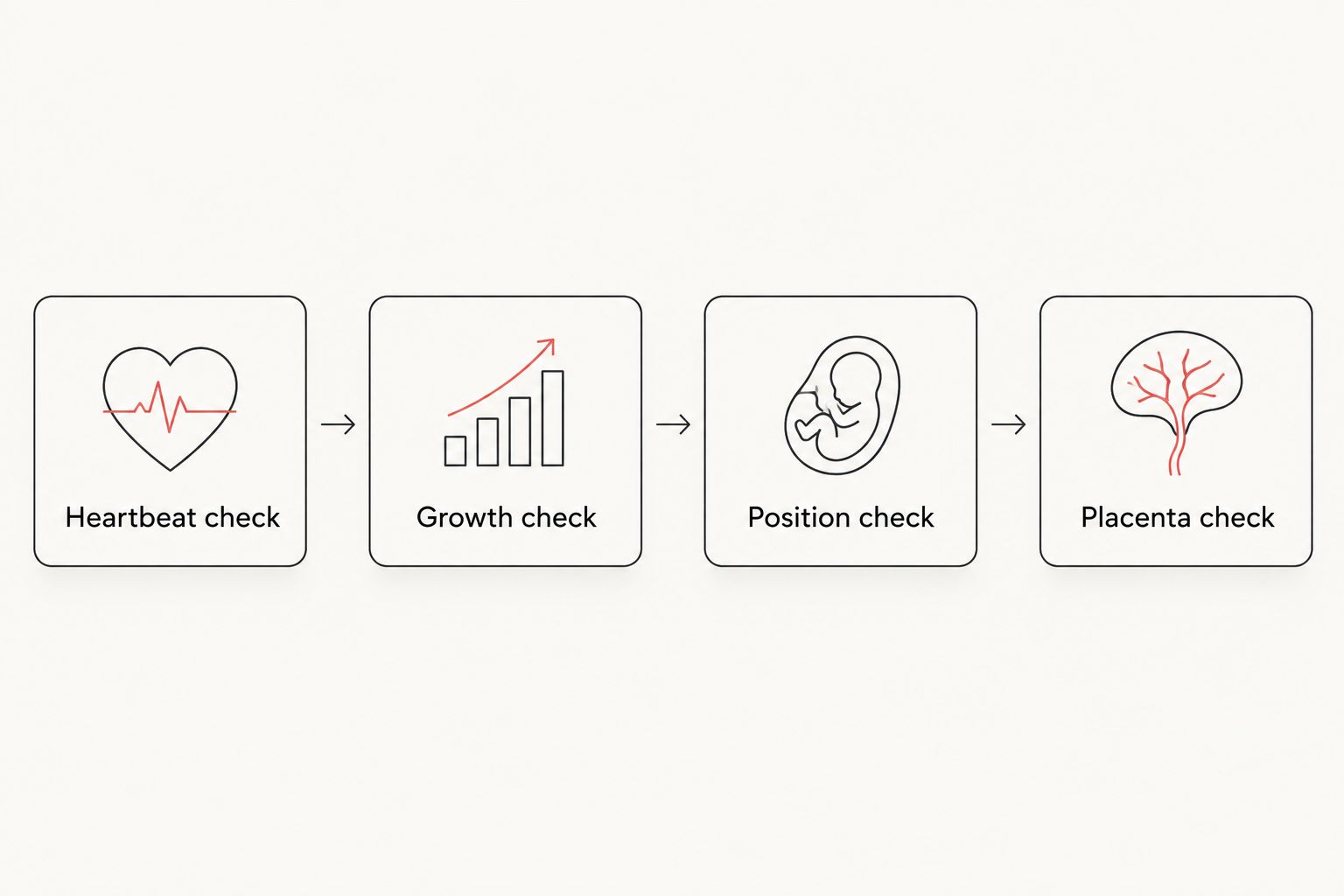
- Book it to check heartbeat, growth, position, or placenta status — pick one goal per visit.
- The Ultrasound Concierge offers a private, unhurried setting in Keller and Willow Park, TX for these interim checks in 2026.
- A reassurance scan cannot rule out chromosomal conditions or replace an MFM-ordered growth study.
Why this matters for high-risk pregnancies
High-risk patients typically see their OB or MFM specialist more often than a standard pregnancy schedule allows, but the gaps between those visits still stretch two to four weeks. That waiting window is where anxiety spikes — after a prior loss, after a diagnosis of a marginal placenta, after a scare with reduced movement. A reassurance ultrasound near Fort Worth exists specifically to shorten that window without replacing the formal, diagnostic-grade scans your specialist orders.
The goal isn't to add more clinical noise. It's to get a same-week look at one specific concern — heartbeat, growth, or position — in a calm setting, then hand that information to the provider managing your actual risk factors.
Identify your risk factor and your scan goal first
Before booking anything in 2026, name the specific reason you're high-risk and the specific question you want answered. A twin pregnancy patient worried about growth discordance needs a different scan than a patient managing gestational hypertension worried about fluid levels.
- Prior pregnancy loss or stillbirth
- Twin or multiple pregnancy
- Gestational diabetes or hypertension
- Advanced maternal age (35+)
- Placenta previa or low-lying placenta
- History of preterm labor
- Reduced fetal movement in the past 48 hours
Time the scan to fill the gap in your OB schedule
Reassurance scans work best scheduled in the middle of the longest gap between your OB or MFM appointments, not the day before or after one. If your next check-in is three weeks out and you're eight days past your last one, that midpoint is when a heartbeat or movement check does the most good.
- Map your OB/MFM visit dates on a calendar before booking
- Book the reassurance scan at the widest gap, not the soonest available slot
- Avoid stacking it within 48 hours of a routine visit — it won't add new information
- Note the date and week of pregnancy in your own records for your provider
Pick the type of reassurance scan that matches your concern
A general "check on baby" request wastes the appointment. Tell the sonographer the single thing you need confirmed, and the scan gets built around it.
- Heartbeat and rhythm check (Doppler)
- Growth and estimated weight check
- Fetal position check (especially useful late third trimester)
- Placenta location and appearance check
- Amniotic fluid level check
A private studio like The Ultrasound Concierge can run any of these as a focused, unhurried visit rather than a rushed slot between hospital patients — that's the faster path once you've named your goal, not a substitute for it.
Prepare your questions and history before the appointment
High-risk patients often arrive with a mental list of worries and forget half of them once the wand touches skin. Write it down.
- Any bleeding, cramping, or fluid leakage since the last visit
- Changes in fetal movement pattern, timed if possible
- Current medications tied to the risk factor (insulin, blood pressure meds)
- The exact week and day of pregnancy at the time of the scan
- Whether your OB or MFM wants a copy of the images sent directly
Understand what a reassurance scan can't replace
This is the step high-risk patients skip and shouldn't. A 20-30 minute reassurance scan confirms the thing you asked about — it does not diagnose chromosomal conditions, replace a formal growth study, or substitute for an MFM-ordered biophysical profile.
- Not a substitute for a nuchal translucency or anatomy scan ordered by your OB
- Not diagnostic for genetic or chromosomal conditions
- Not a replacement for an MFM-ordered growth or Doppler study in twin or IUGR pregnancies
- Not a substitute for emergency evaluation if you have bleeding, severe pain, or no fetal movement — call your provider or go to labor and delivery instead
The Ultrasound Concierge is explicit about this limitation with every patient before the scan starts, because a reassurance visit that's mistaken for a diagnostic one does more harm than good.
Send the results to your OB or MFM specialist afterward
A reassurance scan only closes the loop if the provider managing your risk factor sees it. Request a printed or digital report at the end of the visit and forward it the same day.
- Ask for a written summary, not just images
- Email or upload the report to your OB's patient portal same-day
- Flag anything unexpected (position change, fluid concern) for a same-week call, not the next scheduled visit
- Keep a personal folder of scan dates and findings across the pregnancy

Comparison: where high-risk patients get reassurance scans
| Option | Best for | Key limitation |
|---|---|---|
| Hospital OB department | Patients already admitted or between formal visits at the same facility | Booking is often tied to OB availability, not same-week requests |
| Radiology/imaging center | Patients who need a scan ordered and billed through insurance | Appointments run on a clinical schedule with less flexibility for a quick reassurance-only visit |
| Concierge private studio (The Ultrasound Concierge) | High-risk patients in Keller and Willow Park, TX who want a focused, same-week check without a hospital wait | Elective and not a substitute for MFM-ordered diagnostic studies |
| Mobile/in-home ultrasound | Patients on bed rest or with mobility limits | Fewer available time slots and equipment varies by provider |
Verdict: high-risk patients use a concierge scan to fill the gap between medical visits, and rely on their OB or MFM for every diagnostic decision.
Book a focused reassurance scan
Private, unhurried appointments in Keller for high-risk pregnancy check-ins.
Common mistakes high-risk patients make
- Treating a reassurance scan as a diagnostic replacement. Skipping an MFM-ordered growth study because a reassurance scan "looked fine" leaves real risk unmonitored.
- Booking without a specific goal. "Just checking on baby" wastes the sonographer's time and the patient's money — name heartbeat, growth, position, or placenta.
- Waiting until symptoms are severe. A reassurance scan is for anxiety and gaps in the schedule, not for active bleeding or absent movement — that's an emergency call, not an appointment.
- Not forwarding results to the OB or MFM. A scan that never reaches the specialist managing the risk factor accomplishes nothing clinically.
- Booking too close to the next scheduled visit. Two scans within 48 hours rarely show a meaningful change and often just add cost without new information.
FAQ
What is a reassurance ultrasound for a high-risk pregnancy?
It's an elective scan booked between OB or MFM visits to check one specific concern — heartbeat, growth, position, or placenta — when a known risk factor makes the wait between appointments feel too long. It doesn't replace diagnostic scans ordered by your specialist.
Can a reassurance scan detect problems my OB missed?
A reassurance scan can confirm heartbeat, movement, or position, but it is not diagnostic-grade and cannot rule out chromosomal conditions or replace an MFM-ordered growth study. Any unexpected finding should go straight to your OB or MFM, not be treated as a final answer.
How often should a high-risk patient book reassurance scans?
There's no fixed schedule — book at the midpoint of the widest gap between your existing OB or MFM appointments, and only when a specific concern (reduced movement, anxiety after a prior loss) justifies it. Stacking scans too close together adds cost without new information.
Is a reassurance ultrasound the same as a growth scan?
No. A growth scan is a formal, diagnostic study ordered by an OB or MFM specialist to measure fetal weight against gestational age. A reassurance scan can check growth informally, but it doesn't replace the ordered study for high-risk conditions like twin pregnancies or gestational diabetes.
Where can high-risk patients in Keller and Willow Park get a reassurance scan in 2026?
The Ultrasound Concierge offers private, appointment-based reassurance scans in the Keller and Willow Park, TX area for patients who want a focused check between scheduled OB or MFM visits.
Does a reassurance scan replace an emergency visit?
No. Bleeding, severe pain, or a sudden absence of fetal movement calls for immediate contact with your OB or a trip to labor and delivery, not a scheduled elective scan.
What should I bring to a reassurance ultrasound appointment?
Bring your current week of pregnancy, any symptoms since your last OB visit, current medications tied to your risk factor, and a specific question you want the scan to answer.
Can twin pregnancies get reassurance scans between MFM visits?
Yes — twin pregnancies often have shorter, more frequent MFM visit schedules already, and a reassurance scan can still fill an anxious gap for a heartbeat or position check between those formal appointments.
One last thing
The single biggest misunderstanding high-risk patients bring into a reassurance ultrasound is timing: they book it right before or after an OB visit out of habit, when the scan does the most good at the widest gap in the schedule. Mark your next three OB or MFM dates before you book anything in 2026, then schedule the reassurance visit at the midpoint — that's the appointment that actually changes how the next two weeks feel.