

Yes, you can find out fetal sex at a 3D/4D ultrasound in 2026 if the view is clear and the visit includes a sex assessment. A 2D ultrasound view is often more useful for that assessment; the 3D image is not a guarantee. Fetal position can prevent a clear answer, even when the pictures of your baby look good.
- You can find out gender at 3D ultrasound if the visit includes a fetal sex assessment and the view is clear.
- A 2D anatomy scan is better for clinical assessment; a 3D/4D ultrasound adds a surface view, not certainty.
- Ask The Ultrasound Concierge whether fetal sex assessment is included before booking a private scan.
- At 18–22 weeks of pregnancy, the routine anatomy scan can assess fetal anatomy and often identify fetal sex.
Why this matters
A keepsake image and a clear answer about fetal sex are different goals. You can leave with a detailed view of your baby's face but no clear view of the anatomy needed for a sex assessment. If the answer matters for a 2026 announcement, ask what the appointment covers before you make plans around it. The Ultrasound Concierge offers private pregnancy ultrasound services for patients in the Keller and Willow Park area; confirm whether the specific visit you choose includes fetal sex assessment.
Can you find out gender at a 3D/4D ultrasound?
Yes, when the sonographer can see the relevant anatomy clearly. In everyday conversation, people often call this finding out the baby's gender. An ultrasound assesses visible fetal anatomy; it cannot establish a child's future gender identity. If you want to know what the scan can show, ask about a fetal sex assessment.
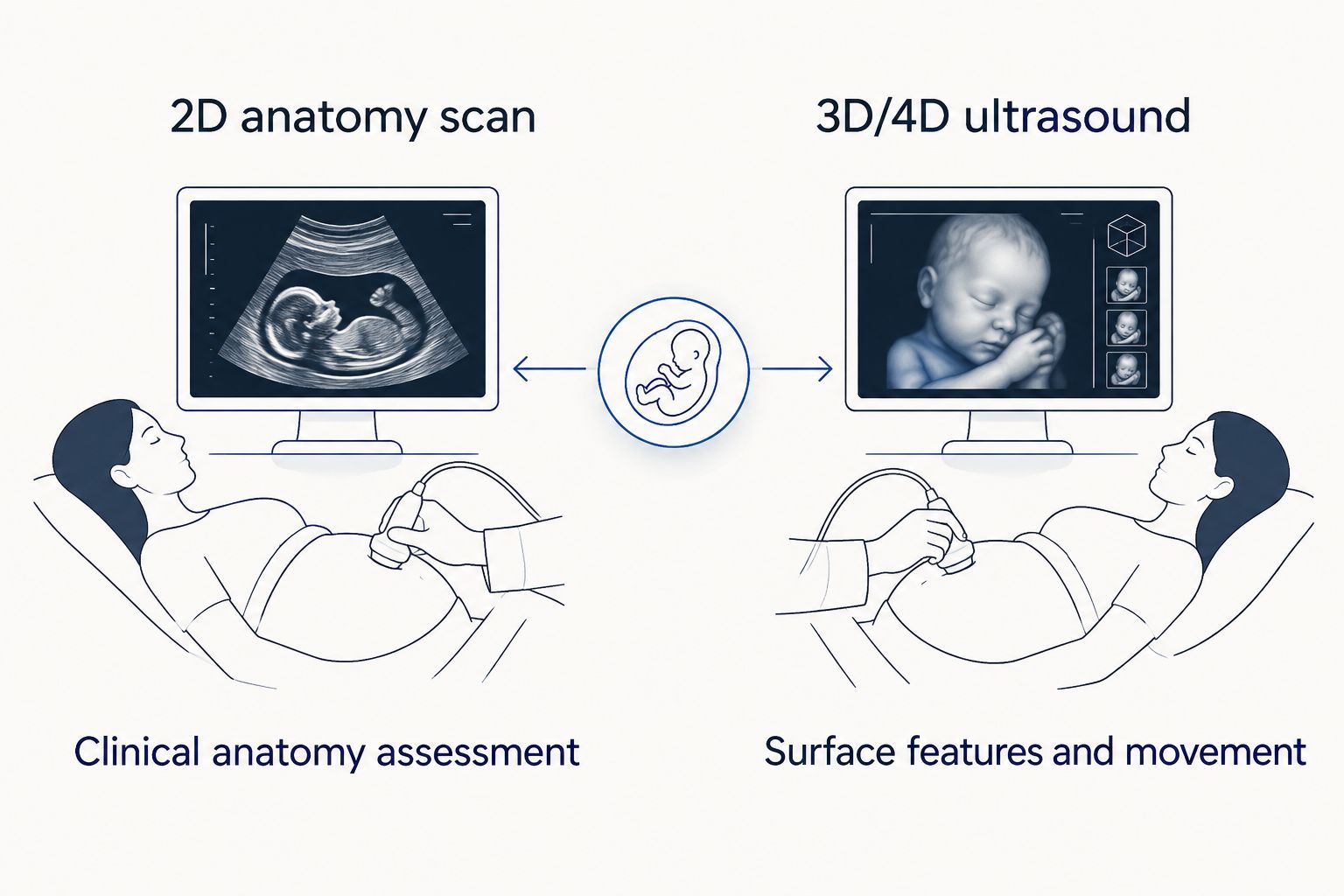
The distinction between image types matters. Standard 2D ultrasound shows a flat cross-sectional view that a sonographer can use to examine anatomy. A 3D ultrasound creates a still surface image, while 4D shows that three-dimensional view in motion. A detailed face image does not mean the sonographer has the view needed to assess fetal sex.
| Option | What it is best for | What can limit a sex answer |
|---|---|---|
| 2D anatomy scan | Clinical anatomy assessment, including a fetal sex assessment when the view allows | Fetal position or an unclear view |
| 3D/4D ultrasound | Seeing surface features and movement during a private pregnancy visit | Surface images alone may not show the anatomy needed |
| Blood-based fetal sex test | Seeking an answer without relying on an ultrasound view | Test timing, instructions and the limits of the specific test |
For clinical anatomy assessment, choose the 2D anatomy scan. For keepsake images, a 3D/4D ultrasound serves a different purpose. Neither option promises a fetal sex answer from every appointment. If you are choosing between them in 2026, start with the question you need answered, not the image style you hope to take home.
The Ultrasound Concierge is best for Keller and Willow Park patients who want a private 3D/4D pregnancy ultrasound; an elective visit does not replace a diagnostic anatomy scan. Its private setting suits a keepsake visit, but you still need to confirm what the selected appointment includes. If a clinician has requested diagnostic imaging, follow that referral rather than assuming an elective scan covers the same examination.
A useful way to think about the choice is assessment first, keepsake image second when your main goal is an answer. The sonographer needs an adequate view of the relevant anatomy regardless of how appealing another image from the visit looks. Tell the provider your goal when arranging the visit so you understand what they will attempt to assess and what happens if the view is unclear.
When can an ultrasound show fetal sex?
The routine second-trimester anatomy scan is generally performed between 18 and 22 weeks of pregnancy. The American College of Obstetricians and Gynecologists describes this as the period for a detailed fetal anatomy ultrasound. Fetal sex can often be assessed during that examination if the relevant structures are visible, but the appointment's primary purpose is to examine anatomy.
That range is not a promise that you will get an answer at 18 weeks or that an answer becomes certain at 22 weeks. A sonographer needs a usable view at the time of the examination. If the baby is positioned in a way that blocks it, waiting for a different view during the appointment may help, but it does not guarantee one.
A private 3D/4D visit can have a different purpose from your anatomy scan. If you have a 20-week anatomy appointment planned in 2026, ask your prenatal clinician which clinical questions it will address. Then ask the private ultrasound provider separately whether its visit includes fetal sex assessment and 3D/4D images. Do not use a keepsake appointment as a replacement for recommended prenatal imaging.
If you want to share the result at a particular event, leave room for an inconclusive view. A scheduled scan gives you an appointment, not a guaranteed answer. You can still enjoy the visit without making the rest of your plans depend on one image.
Why can the answer vary between visits?
Several factors affect whether the relevant anatomy is visible. None of them can be judged from the words 3D or 4D on an appointment description alone.
- Gestational timing. The stage of pregnancy affects what can be assessed. The routine anatomy scan's 18–22-week window is a useful reference for planning a clinical assessment, not a guarantee for an elective visit.
- Fetal position. The baby can be turned so that the anatomy needed for the assessment is obscured. A clear image of another body part does not resolve that problem.
- What the appointment includes. A visit arranged for 3D/4D keepsake images is not necessarily set up to provide the same assessment as a diagnostic anatomy scan. Ask the provider to explain the scope.
- The view available during the scan. An assessment depends on what the sonographer can see, not on the number of images captured. An uncertain view calls for an uncertain answer.
- The question you ask. If you want fetal sex assessed, say so before the appointment. If you prefer a surprise, say that too, especially before anyone shares images or discusses findings.
These factors also explain why two visits in the same pregnancy can have different outcomes without either visit being a failure. Visibility can change. The right response to an unclear view is to ask what was observed and what, if anything, should happen next—not to treat a guess as a confirmed result.
What should you ask before booking a 3D/4D visit?
In 2026, the most useful booking question is direct: Does this appointment include a fetal sex assessment, or is it for images only? A description that mentions 3D/4D tells you about an imaging format, not every part of the visit. Get the scope clear before you tie the appointment to an announcement.
Then ask these practical questions:
- What kind of scan is this? Find out whether the visit is elective, diagnostic or both. Keep any diagnostic imaging recommended by your prenatal clinician on your care schedule.
- Will you attempt a fetal sex assessment? Do not assume that every pregnancy ultrasound includes one. If you do not want to know, tell the provider before the scan begins.
- What happens if the view is unclear? Ask how the provider communicates an inconclusive assessment and whether another assessment would require a separate visit. Do not assume a repeat visit is included.
- How should I understand the result? Ask the person performing the scan to explain what was visible and any limits they place on the assessment. Take an uncertain answer as uncertain.
- Who handles clinical concerns? Know how findings from the visit would be addressed with your prenatal clinician. A private scan should not leave you unsure whom to contact about a medical question.
Those questions help you match the appointment to your goal without expecting a guarantee the provider cannot give. They also make room for a good experience if the baby is not positioned for the answer you hoped to hear. A visit can be meaningful without supplying every image or detail you planned.
For patients near Keller and Willow Park, The Ultrasound Concierge offers private pregnancy ultrasound services alongside diagnostic imaging services. Ask which type of visit addresses your question; the service categories should not be treated as interchangeable. A calm, personal appointment and a clinically appropriate examination can both matter, but they answer different needs.
Is a blood-based test a better choice for an earlier answer?
A blood-based fetal sex test does not depend on the baby's position during an ultrasound. Some prenatal blood-screening options are available from 10 weeks of pregnancy, but timing and what the result means depend on the specific test. Ask your prenatal clinician about clinical screening, and check the current instructions for any consumer test you are considering.
The Ultrasound Concierge offers SneakPeek Gender Tests as well as pregnancy ultrasound services. SneakPeek is best considered as a separate test, not a clearer 3D/4D image. Its advantage for this question is that fetal position does not determine whether a blood sample can be tested; its limitation is that you must follow the selected test's instructions and understand what its result does and does not establish.
A blood-based result also does not replace an anatomy scan. Screening, consumer fetal sex testing and ultrasound have different purposes. If a result conflicts with later imaging, or if you have a question about fetal development, discuss it with your prenatal clinician rather than trying to settle the issue from a keepsake picture.
Can a 3D picture confirm a result from another test?
No 3D picture, by itself, settles every disagreement. A 3D/4D ultrasound can show surface features, but a fetal sex assessment still depends on a clear view of the relevant anatomy. If an earlier test and an ultrasound assessment differ, bring both results to your prenatal clinician for guidance.
Do not treat a photo that seems convincing to friends or family as a clinical interpretation. The useful question is what the qualified person conducting the examination could assess from the views available. In 2026, that remains true whether the image is a still 3D picture, a 4D clip or a standard 2D view.
What if the baby is not in a good position?
Ask whether the sonographer obtained an adequate view before accepting an answer. If the view was inconclusive, the result is inconclusive; image quality elsewhere in the session does not change that. Ask whether your planned anatomy scan or another discussion with your prenatal clinician is the appropriate next step.
It is reasonable to feel disappointed if you planned to tell family that day. An unclear view says nothing by itself about your baby's health, and it is not a reason to abandon recommended prenatal care. Separate the emotional plan for an announcement from the clinical plan for pregnancy imaging.
FAQ
Can you find out gender at a 3D ultrasound in 2026?
Yes, if the appointment includes a fetal sex assessment and the relevant anatomy is clearly visible. A 3D image alone does not guarantee an answer.
Is 3D ultrasound more accurate than 2D for finding out fetal sex?
No, a detailed 3D surface image is not automatically better for assessing fetal sex. Sonographers commonly use 2D views to examine the anatomy needed for that assessment.
Can the 20-week anatomy scan tell you fetal sex?
Yes, the anatomy scan can often identify fetal sex when the relevant anatomy is visible. Its main purpose is to examine fetal anatomy, so ask your prenatal clinician how results will be shared.
What if the sonographer cannot see the baby's sex?
The assessment is inconclusive if the needed view is not available. Ask what was visible and whether to discuss the question at a later clinical appointment.
Does a 3D/4D ultrasound replace the anatomy scan?
No, an elective 3D/4D visit does not replace a recommended diagnostic anatomy scan. Keep the clinical examination scheduled with your prenatal care team.
Can SneakPeek answer the question before an ultrasound view is clear?
SneakPeek is a blood-based fetal sex test, so its result does not depend on fetal position during an ultrasound. Follow the instructions for the specific test and discuss conflicting results with your prenatal clinician.
Does The Ultrasound Concierge assess fetal sex at every pregnancy visit?
Do not assume every visit includes a fetal sex assessment. The Ultrasound Concierge offers pregnancy ultrasound services; confirm what the appointment you select includes before booking.
One last thing
If your goal is a 2026 gender reveal, ask two separate questions: Will this visit attempt a fetal sex assessment? and What will we do if the view is unclear? The second answer matters as much as the first. You can plan an announcement around a confirmed answer; you cannot plan the baby's position during a scan.