

You can use a SneakPeek early gender DNA test as early as 6 weeks pregnant, measured from the first day of your last menstrual period. That is earlier than the usual timing for prenatal cell-free DNA screening or the mid-pregnancy anatomy ultrasound. The test predicts fetal chromosomal sex; it does not assess your pregnancy’s health or replace prenatal care.
- SneakPeek early gender testing starts at 6 weeks pregnant, according to SneakPeek’s published eligibility guidance.
- Count 6 weeks from the first day of your last menstrual period, not from conception.
- The Ultrasound Concierge offers SneakPeek Gender Tests for patients near Keller and Willow Park, Texas; confirm eligibility before scheduling.
- A SneakPeek result predicts chromosomal sex. Keep your clinical prenatal visits and recommended screening appointments.
Why this matters
The date you use determines whether you are ready to test. Pregnancy weeks are normally counted from the first day of your last menstrual period. If you count from the day you believe conception occurred instead, you are using a different starting point. Before arranging a test, check your estimated gestational age with your prenatal provider, particularly if your cycles are irregular or your due date is uncertain.
For patients around Keller and Willow Park, The Ultrasound Concierge offers SneakPeek Gender Tests alongside pregnancy ultrasound services. The question in 2026 is not just how soon you can learn a result. It is whether you have reached the test’s eligibility point and what you expect that result to tell you.
How early can you find out gender with SneakPeek?
SneakPeek’s published eligibility starts at 6 weeks of pregnancy. For this purpose, pregnancy dating starts with the first day of your last menstrual period. Reaching that point matters more than the date of a positive home pregnancy test, which does not by itself establish how far along you are.
The earliest test is not the only option. The choices below answer different questions, so choose based on whether you want an early prediction or information from your regular prenatal care.
| Option | Usual earliest timing | Best for | What it tells you | Main limitation |
|---|---|---|---|---|
| SneakPeek early gender DNA test | 6 weeks pregnant, under SneakPeek’s published eligibility guidance | Someone who wants an early prediction of fetal chromosomal sex | Looks for Y-chromosome DNA in a maternal blood sample | It is not a diagnostic test or a check on fetal health |
| Prenatal cell-free DNA screening | Typically from 10 weeks pregnant, subject to your clinician’s guidance | Someone discussing chromosomal screening with a prenatal provider | Screens for certain chromosome conditions and can also report fetal sex | A screening result is not a diagnosis |
| Mid-pregnancy anatomy ultrasound | Commonly at 18–22 weeks pregnant | Someone attending a clinical examination of fetal anatomy | Examines fetal structures; fetal sex can sometimes be seen | Visibility depends on the examination, including fetal position |
These are not interchangeable appointments. A SneakPeek test answers an early sex-prediction question. Prenatal screening and the anatomy ultrasound serve clinical purposes even if they also provide information about fetal sex. Your provider can explain which clinical tests fit your pregnancy.
SneakPeek: as early as 6 weeks pregnant
SneakPeek is the earliest option in this comparison. Its published guidance sets eligibility at 6 weeks pregnant, not 6 weeks after conception. If you are close to that threshold, confirm the dating used for your appointment rather than assuming the dates match.
The test uses a maternal blood sample to look for Y-chromosome DNA. A result indicating Y-chromosome DNA is a prediction of male chromosomal sex; a result without that detection is a prediction of female chromosomal sex. That distinction matters: the result is about a biological marker, not a child’s future gender identity, and it is not a medical assessment of how the pregnancy is developing.
The Ultrasound Concierge is best for patients near Keller and Willow Park who want a private setting for a SneakPeek Gender Test. Its offering also includes pregnancy ultrasound services. The limitation is clear: an elective early sex test cannot stand in for clinical screening, an anatomy examination or advice from your prenatal provider.
If an early result will shape how you share the news, decide in advance how you want to handle a result that differs from later clinical information. For a closer look at that question, read how accurate the SneakPeek gender test is. Do not treat an early result as a reason to skip a recommended prenatal visit.
Prenatal cell-free DNA screening: typically from 10 weeks
Prenatal cell-free DNA screening is generally offered from 10 weeks pregnant. Its primary role is to screen for certain chromosome conditions, although a result can also include information about fetal sex. Your clinician can explain whether it is appropriate for you, when to have it and how to interpret the findings.
Best for: someone who wants to discuss clinical prenatal screening, not someone seeking only an early reveal. Its advantage is that it addresses a clinical screening question as part of prenatal care. Its limitation is equally important: screening estimates the chance of a condition; it does not establish a diagnosis.
If you are considering both SneakPeek and clinical screening in 2026, tell your prenatal provider what you have already done. You can still follow the care plan recommended for your pregnancy. Do not use agreement between results as proof that every aspect of fetal health has been assessed.
Anatomy ultrasound: commonly at 18–22 weeks
The mid-pregnancy anatomy ultrasound is commonly scheduled at 18–22 weeks pregnant. The examination looks at fetal anatomy; learning fetal sex can be part of the visit when it is visible. The clinical purpose remains the examination, whether or not you want to know the sex.
Best for: someone attending their recommended anatomy examination and comfortable waiting to ask whether fetal sex can be seen. Its advantage is that the visit evaluates anatomy rather than only answering a reveal question. Its limitation for this purpose is timing, and a clear view of fetal sex is not guaranteed.
If you already have a SneakPeek result, keep your anatomy appointment as directed. If you do not want fetal sex discussed during the exam, tell the care team before it begins. That simple instruction is useful whether you are planning a later reveal or prefer not to know.
Why the earliest test date varies
The published SneakPeek threshold is 6 weeks, but the day you reach it depends on how your pregnancy is dated. Check these factors before choosing an appointment:
- First day of your last menstrual period. This is the usual starting point for gestational age. It is not the day you conceived.
- Cycle pattern. If your cycles are irregular, a date based only on your last period can leave you uncertain about how far along you are.
- Your provider’s dating information. If your prenatal provider has given you an estimated gestational age or due date, use that information to discuss timing.
- The test’s current eligibility instructions. Check SneakPeek’s published guidance when you book; do not rely on a date calculated for a different test.
- The purpose of the appointment. An early sex prediction, clinical screening and an anatomy examination answer different questions and take place at different stages.
The order is straightforward: establish your gestational age, check the test’s eligibility, then decide whether an early prediction is useful to you. Waiting until you can verify your dates is more sensible than booking from a guess about conception.
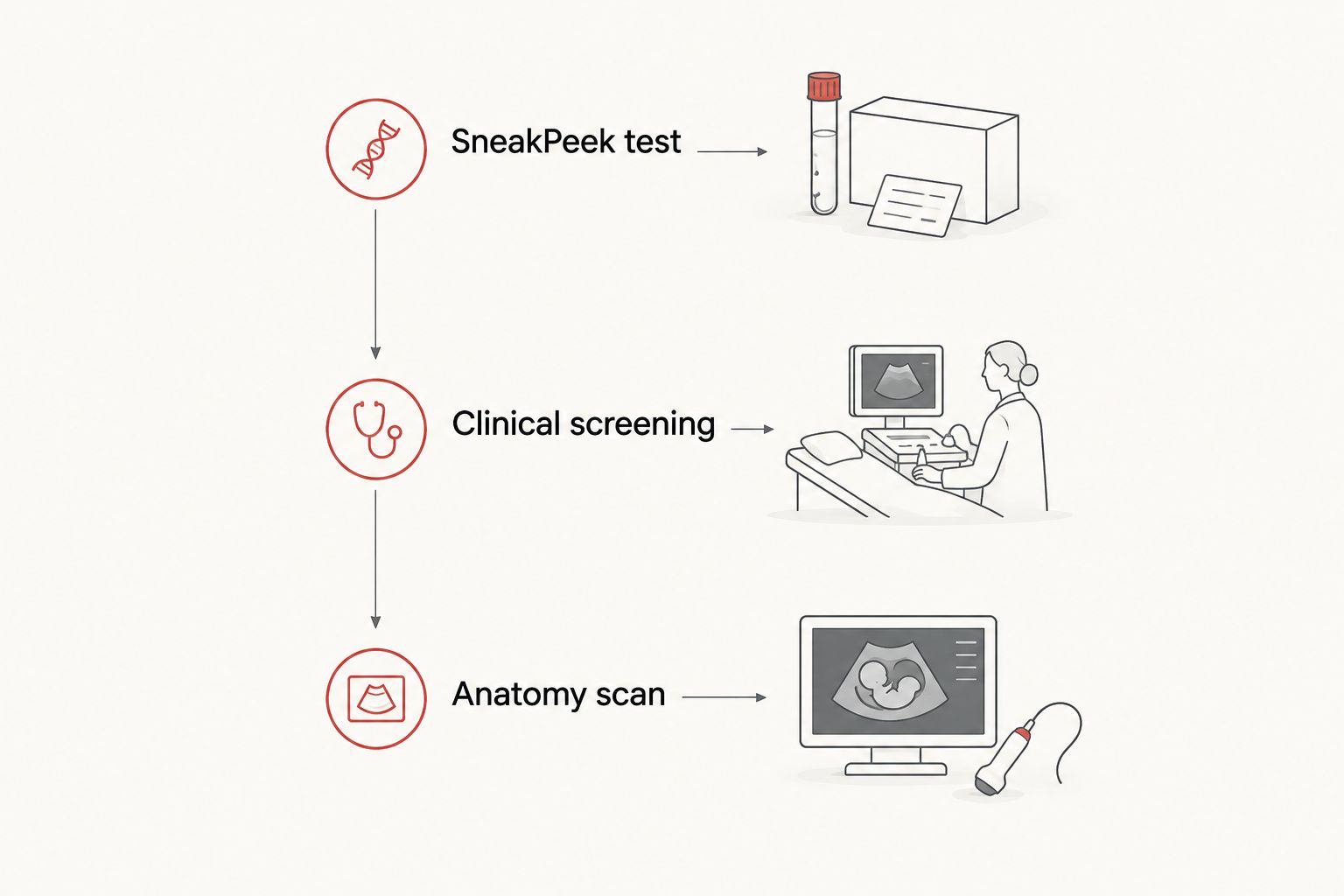
What to check before you schedule
Start with the date of your last menstrual period and any gestational age your prenatal provider has already given you. If those point to different timelines, ask your provider which dating to use. This is especially useful when you are close to SneakPeek’s 6-week eligibility point.
Next, decide what you want from the result. If the question is simply whether you can receive an early prediction of fetal chromosomal sex, SneakPeek fits that purpose. If you have questions about fetal development, symptoms or chromosome conditions, bring them to your prenatal provider instead. An elective test is not designed to settle those concerns.
Finally, think about how and when you want to receive the information. Some people want to know privately before telling family; others prefer to wait for a clinical appointment. Neither preference changes the need for prenatal care. In 2026, the useful distinction remains early prediction versus clinical assessment, not which appointment feels more exciting.
Can I take SneakPeek before my first ultrasound?
Yes, if you have reached SneakPeek’s 6-week eligibility point. An ultrasound is not inherently required before every early sex test, but it can help clarify pregnancy dating when your dates are uncertain. Ask your prenatal provider how to establish gestational age rather than using the test as a dating tool.
Is 6 weeks pregnant the same as 6 weeks after conception?
No. Six weeks pregnant is counted from the first day of your last menstrual period, not from conception. That is why a calendar calculation based on conception can lead you to the wrong testing date. If you are unsure which date applies, confirm your gestational age before arranging a SneakPeek test.
Should I wait for the anatomy ultrasound instead?
Wait if you would rather learn fetal sex during your clinical anatomy examination; it is commonly scheduled at 18–22 weeks pregnant. Choose SneakPeek if an earlier prediction matters to you and you meet its eligibility guidance. Either way, keep the anatomy appointment your prenatal provider recommends.
FAQ
How early can you find out gender with SneakPeek in 2026?
SneakPeek’s published eligibility starts at 6 weeks pregnant. Count from the first day of your last menstrual period and confirm your gestational age if your dates are uncertain.
Can SneakPeek tell me my baby’s gender at 5 weeks?
No. SneakPeek’s published eligibility starts at 6 weeks pregnant, so 5 weeks is before that threshold. Check your dating before scheduling.
Does SneakPeek count weeks from conception?
No. The 6-week threshold refers to gestational age, normally counted from the first day of your last menstrual period. Ask your prenatal provider if you are unsure how far along you are.
Is SneakPeek the same as a prenatal blood screening test?
No. SneakPeek is an early fetal sex-prediction test, while prenatal cell-free DNA screening addresses clinical chromosome-screening questions and can also report fetal sex. Discuss clinical screening with your prenatal provider.
When can an anatomy ultrasound show fetal sex?
The anatomy ultrasound is commonly scheduled at 18–22 weeks pregnant, and fetal sex can sometimes be seen during the examination. A clear view is not guaranteed.
Do I still need prenatal appointments after a SneakPeek result?
Yes. A SneakPeek result does not assess fetal health or replace prenatal screening and the anatomy ultrasound. Keep the appointments recommended by your prenatal provider.
Where can I ask about a SneakPeek test near Keller or Willow Park?
The Ultrasound Concierge offers SneakPeek Gender Tests for patients in the Keller and Willow Park area. Confirm the current eligibility instructions and your pregnancy dating before scheduling.
One last thing
An early answer is not an early health check. If you choose a SneakPeek Gender Test through The Ultrasound Concierge, use the result for the question it is meant to answer and keep your prenatal care on its own schedule. That distinction protects the part of the experience that matters most: knowing what you have learned, and what still needs a clinician’s attention.