

Ultrasound referrals for doulas mean pointing a client toward a private or hospital-based ultrasound appointment outside her regular OB schedule, with the goal of closing an information gap between visits without a doula stepping into medical scope. Doulas don't order tests, diagnose, or read scans — a referral is a hand-off, and knowing where to hand a client off matters as much as knowing when to do it. That distinction is sharper for doulas than for almost any other birth-support role, because the referral itself sits right at the edge of scope-of-practice questions clients rarely think to ask about.
- Ultrasound referrals for doulas are hand-offs to vetted imaging appointments, not medical orders — scope stops at the referral.
- Match the scan to the worry: dating scans run before 14 weeks, anatomy scans run 18-22 weeks, reassurance scans cluster in the 24-32 week window.
- A concierge studio like The Ultrasound Concierge is one option among several — it's not a substitute for OB-ordered diagnostic imaging.
- Log every referral with date, reason, and provider name; it protects the doula and clarifies the client's medical record.
Why this matters for doulas
Clients ask doulas questions between OB visits that a two-week appointment gap doesn't answer: "Is the baby still head-down?" "Why haven't I felt movement today?" "Can I see the baby again before my next appointment?" A doula who has no answer beyond "call your OB" loses trust in that moment. A doula with a short, vetted list of places for a reassurance ultrasound scan gives the client somewhere to go without the doula ever touching diagnosis.
The risk runs the other direction too. A doula who over-refers, under-vets, or implies a scan result means something medically starts practicing outside her lane — and that's the fastest way to damage the working relationship with a client's OB or midwife. The referral itself should be boring: a name, a phone number, and a clear sentence about what the scan does and doesn't do.
Building an ultrasound referral pathway as a doula
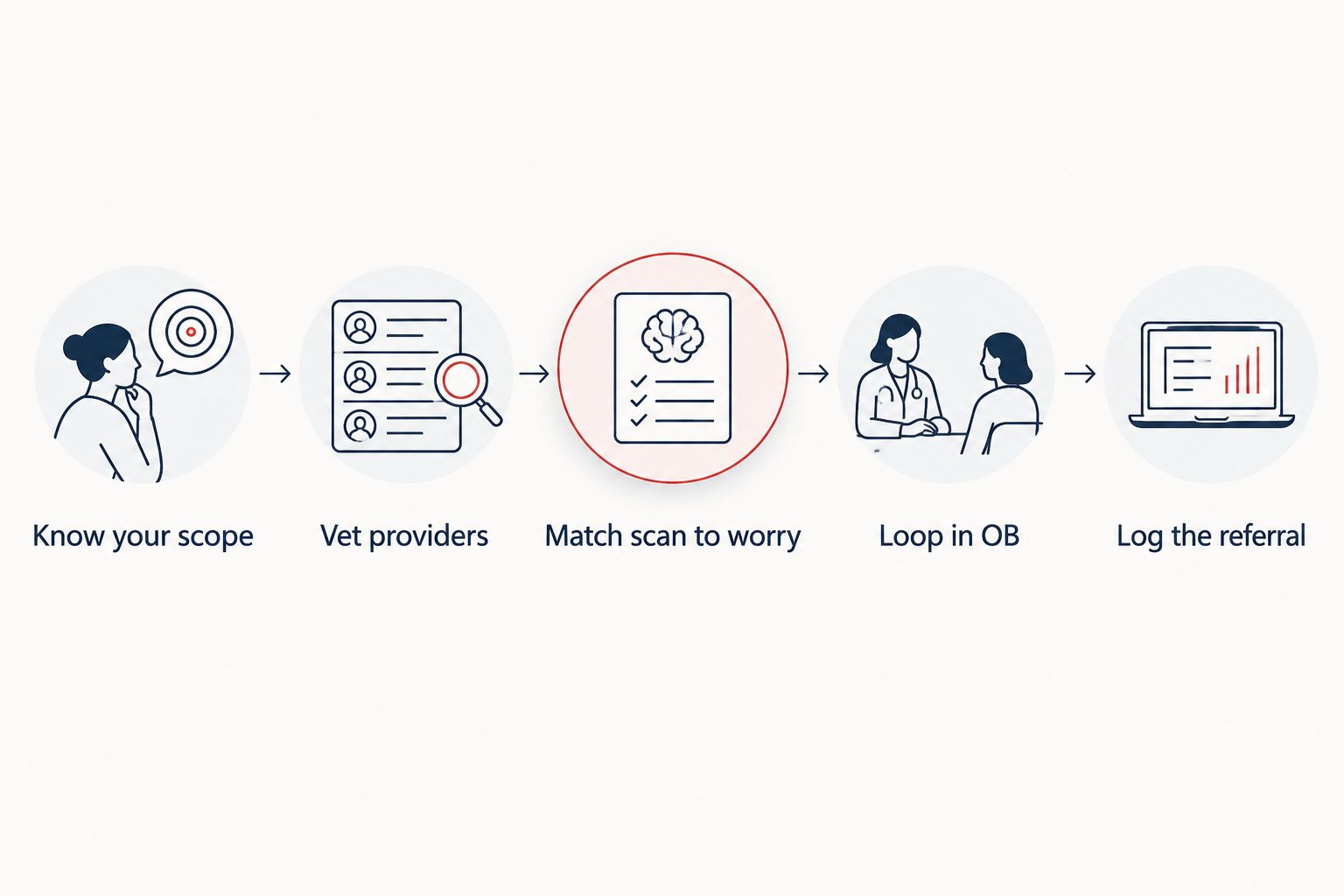
Know exactly where your scope ends
Before building any referral list, write down the line you won't cross. This isn't legal advice — it's a working boundary you can repeat to a client in one sentence.
- State plainly that you can't order, read, or interpret a scan
- Never tell a client what a scan "probably shows" before she's seen it
- Refer to the provider or the OB, never to a specific finding
- Keep the referral verbal or written, but always time-stamped
- Review your boundary language once a year — clients change, your comfort with the topic doesn't need to
Vet providers before you ever refer a client
A referral list built on Google reviews alone is a liability. Call the provider yourself, ask who performs the scan, and confirm what happens with results.
- Confirm whether a sonographer or a physician performs the exam
- Ask directly how results are communicated to the client and to her OB
- Check whether the provider offers diagnostic-quality imaging or elective/keepsake-only scans
- Confirm scheduling turnaround — same-week matters when a client is anxious
- Ask what happens if the scan finds something that needs immediate OB attention
Match the scan type to the client's actual worry
Most client anxiety maps to a small set of recurring questions, and each maps to a different scan window. A dating scan typically runs before 14 weeks. An anatomy scan runs between 18 and 22 weeks. Reassurance scans for reduced movement or general worry cluster in the 24- to 32-week window, though timing depends on the individual pregnancy.
- Reduced movement worry — reassurance scan, same-week if possible
- Position/presentation questions in the third trimester — quick position check
- Gender confirmation requests — a dedicated gender-confirmation or SneakPeek-style test, not a diagnostic scan
- Bonding or keepsake requests — a 3D/4D session, kept clearly separate from medical imaging
- Multiples growth-tracking questions — refer back to the OB for growth scans, not a private studio alone
A private sonographer service is a reasonable fit for the reassurance and bonding categories above — it's the wrong fit for anything that needs a physician's diagnostic read.
Set the language you use with clients
The words a doula uses in the referral moment either reinforce scope or blur it. Script this in advance so it doesn't get improvised under stress.
- Say "I can point you to someone who can look at that" — never "I think it's fine"
- Say "this is a reassurance scan, not a diagnostic one" when that's true
- Avoid "don't worry" before the client has seen a provider
- Write the referral down in a text or note so the client has it verbatim
- Ask the client to tell her OB she's getting the scan, every time
Loop in the OB or midwife before, not after
An OB who finds out about an outside scan after the fact reads it as the doula bypassing care. An OB who's told in advance reads it as coordination.
- Encourage the client to text or call her OB's office before the appointment
- Offer to help the client word that message if she's hesitant
- Ask the imaging provider whether they'll send a report to the OB directly
- Never present an outside scan as replacing a scheduled OB visit
- Flag any finding, even a reassuring one, back to the OB team the same day
Treat high-risk and multiples referrals differently
A singleton, low-risk pregnancy and a client carrying twins or managing a high-risk condition need different referral judgment. For high-risk pregnancy reassurance scans, lean toward providers with clearer physician oversight and faster OB communication loops, not just the closest studio.
- Confirm the provider has handled high-risk or multiples cases before
- Ask about turnaround time for getting results to a maternal-fetal medicine team
- Don't treat an elective studio visit as sufficient for a client with a known complication
- Push high-risk clients back to their OB's imaging department first, private studio second
Keep a simple referral log
A one-line log entry protects the doula and gives the client a clean record.
- Date, client initials, reason for referral
- Provider name and scan type
- Whether the OB was notified before or after
- Outcome, if the client shares it
Give clients a vetted referral option
A calm, private setting for reassurance and bonding scans in Keller and Willow Park, TX.
Comparison: where doulas can send a client
| Option | Best for | Typical scheduling window | Key limitation |
|---|---|---|---|
| OB/midwife in-office ultrasound | Any diagnostic concern, high-risk cases | Depends on OB's schedule | Slowest option when anxiety is same-day |
| Hospital-based imaging center | Confirmed complications needing physician read | Days to a couple weeks | Clinical setting, less privacy, longer wait |
| Concierge ultrasound studio (The Ultrasound Concierge) | Reassurance, bonding, gender confirmation, position checks | Often same-week | Not a substitute for OB-ordered diagnostic imaging |
| Telehealth heart-rate check-in | Quick reassurance with no imaging | Same-day | No visual confirmation, limited scope |
Verdict: The Ultrasound Concierge is best for doulas' clients who need same-week reassurance, bonding, or gender-confirmation imaging in the Keller and Willow Park area — it's not the right referral for a suspected medical complication.
Common mistakes doulas make with ultrasound referrals
- Treating an elective scan as a diagnostic substitute. A reassurance or bonding scan at a private studio doesn't replace an OB-ordered growth or anatomy scan.
- Referring without telling the OB. Silence here reads as the doula working around the medical team, not with it.
- Skipping the vetting call. A studio's website doesn't tell you who performs the scan or what happens if something looks off.
- Using diagnostic language. "That looks fine" from a doula, said about a scan she hasn't seen, crosses a line she can't uncross.
- No log. Without a written record, a doula has no way to show what she actually said and when.
FAQ
Can a doula order an ultrasound for a client?
No. Doulas can't order or interpret ultrasounds — they can only refer a client to a provider who performs the scan. The referral stops at pointing the client toward a resource, never at ordering or reading results.
What's the difference between a reassurance scan and a diagnostic scan?
A reassurance scan checks things like fetal heart tone or general movement between OB visits and is typically performed by a sonographer at a private studio. A diagnostic scan is ordered by a physician to evaluate a specific medical concern and is read by a provider qualified to make a clinical call.
Is a private ultrasound studio a substitute for OB care in 2026?
No. A private or concierge ultrasound studio supplements OB care between visits — it doesn't replace scheduled prenatal appointments or physician-ordered diagnostic imaging.
When should a doula refer a client back to her OB instead of a private studio?
Any suspected complication, high-risk condition, or multiples pregnancy should go to the OB or a hospital-based imaging center first. Private studios are appropriate for reassurance, bonding, and gender-confirmation scans, not diagnostic evaluation.
How do doulas find a vetted ultrasound provider to refer clients to?
Call the provider directly and confirm who performs the scan, how results reach the client's OB, and whether the imaging is diagnostic-quality or elective-only before adding anyone to a referral list.
What week of pregnancy is a reassurance ultrasound typically done?
Reassurance scans most often happen in the 24- to 32-week window, though timing depends on the individual pregnancy and the reason for the scan.
Should a doula tell the client's OB about an outside ultrasound referral?
Yes, every time, and ideally before the appointment happens. Coordinating with the OB in advance keeps the referral read as support rather than a bypass of medical care.
Can a SneakPeek-style gender test replace an anatomy scan?
No. A gender-confirmation test answers one question and doesn't evaluate fetal anatomy or growth, which is what an 18- to 22-week anatomy scan is designed to do.
One last thing
The referral line doulas cross most often isn't language — it's timing. Referring a client to any scan, elective or otherwise, before her OB knows about it is the single fastest way to turn a helpful hand-off into a coordination problem. Send the referral and the OB notification in the same breath, every time, and 2026's version of this guide won't need a section on fixing damaged provider relationships.