Calling your OB's office the morning of your 3D/4D appointment to beg for a CD of last week's dating scan burns twenty minutes you don't get back. Request the records release when you book, hand the file over at check-in, and your sonographer starts the session already knowing your due date, placenta position, and baby's spine orientation instead of re-measuring everything from scratch.
- Transfer ultrasound images before a 3D/4D session by requesting a signed HIPAA release from your OB's office at least 3-5 business days ahead.
- Ask specifically for DICOM files or a burned CD, not just a printed PDF report -- printed images lose the measurements sonographers need.
- The Ultrasound Concierge in Keller and Willow Park, TX accepts CDs, USB drives, or portal-shared files at check-in, no prior notice email required.
- Confirm gestational age from your OB's dating scan before booking -- 3D/4D imaging windows are tighter than routine anatomy scans.
- Twin pregnancies and repeat visits benefit most from bringing forward the last scan's placenta and position notes.
Why this matters
A 3D/4D session works best when the sonographer isn't starting cold. Your OB's dating scan tells the studio your actual gestational age, which determines whether you're in the window for a good facial profile shot -- typically 27 to 32 weeks, though every pregnancy runs a little differently. Placenta position from a prior scan also flags anterior placentas early, so the sonographer adjusts probe pressure and timing instead of discovering it mid-session.
Skip this step and you're paying for studio time spent re-establishing basics your OB's office already documented. Transferring ultrasound images before your 3D/4D session isn't paperwork for its own sake -- it's the difference between a focused 20-minute bonding session and a slower one spent re-collecting data.
Before you start
- A signed medical records authorization on file with your OB's office. Most practices require this in writing, even for you requesting your own records -- a phone call alone rarely triggers a release.
- Know what format your OB's office actually stores ultrasound images in: DICOM files on a CD, a scanned PDF report, or a patient portal export. Ask directly rather than assuming.
- The gotcha: many OB offices only release the written report and a handful of still frames, not the full cine loop or raw DICOM series. If you want the sonographer at The Ultrasound Concierge to see fetal movement or a full sweep, you have to ask for that specifically -- the default export usually leaves it out.
Request your records release
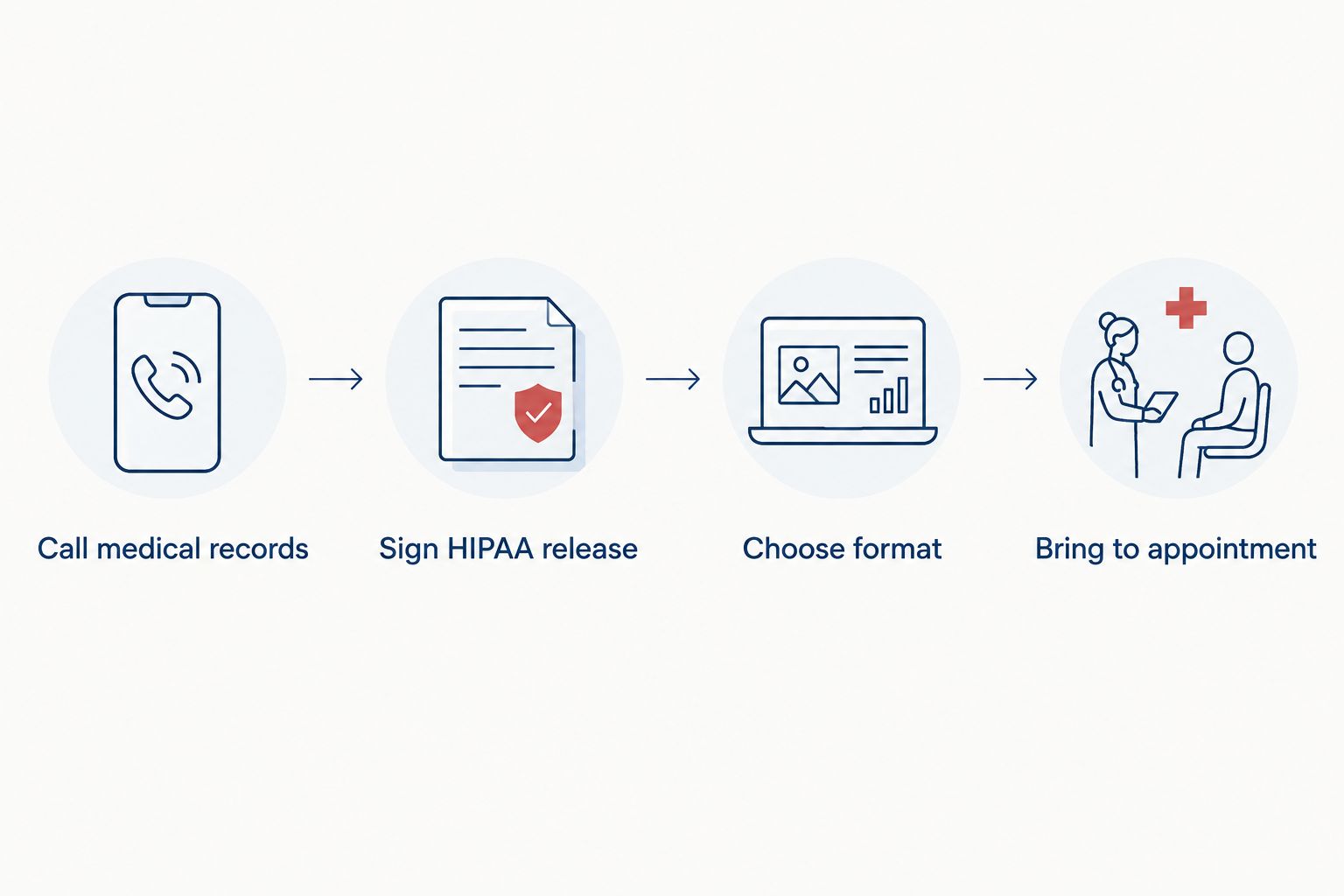
- Call your OB's front desk and ask for the Medical Records or Health Information Management line -- it's often a different number than scheduling.
- Say you want your ultrasound images and report transferred ahead of an outside 3D/4D appointment. Name the date range: your most recent dating or anatomy scan.
- Ask them to check the box for DICOM/imaging files, not just the written report, on their release form. Some offices label this "imaging CD" or "radiology export."
- Sign the HIPAA authorization form -- most offices require this in person, by fax, or through their patient portal's document upload.
- Confirm turnaround time before you leave. Three to five business days is typical; same-day pickup happens at smaller practices but isn't guaranteed.
Expected result: you walk away with either a pickup date for a physical CD or a portal notification once your images are ready to download.
Choose your transfer format
Not every OB office hands you the same thing. Match your request to what actually gets used at your 3D/4D appointment.
| Format | What you get | Works for 3D/4D prep |
|---|---|---|
| Burned CD/DVD with DICOM files | Full imaging series, measurements intact | Best -- bring the physical disc |
| Patient portal PDF export | Static images, written report only | Adequate for dates and placenta notes |
| Printed photos only | A handful of still frames | Weakest -- no measurement data attached |
| USB drive (less common) | Same as CD, more portable | Good if your office offers it |
If your OB's practice uses a patient portal like a hospital-system MyChart, download the imaging report as a PDF before your appointment and save it to your phone -- you can show it at check-in even without a physical disc. For the finished 3D/4D images and video from your session, most studios now text or email files the same day; see how 3D/4D photos and video get sent to your phone for what that hand-off looks like on the other end.
Confirm gestational age before you book
Your OB's dating scan sets your gestational age more accurately than a due-date calculator, and 3D/4D imaging has a narrower ideal window than routine prenatal visits. Baby needs enough amniotic fluid around the face and less bone density blocking the profile -- that window sits roughly between 27 and 32 weeks for most pregnancies, though anterior placentas or baby's position on the day can shift results either direction.
Bring the gestational age from your OB's most recent scan, not your own due-date estimate, when you book. It changes which week the studio recommends and avoids booking too early for a clear 3D image or too late once baby has dropped and engaged.
If you're returning for a follow-up or repeat visit
Twin pregnancies, high-risk monitoring, or a second 3D/4D session later in the same pregnancy all benefit from carrying forward records rather than starting the transfer process over. If your OB has you on a spaced-out prenatal schedule and you want imaging in between visits, the process for booking a reassurance scan between OB appointments uses the same records-transfer steps above -- request the release once, and reuse the same file for every session that follows in the same pregnancy.
For twins specifically, ask your OB's office to label which baby is Twin A and Twin B on the release, since placenta and position notes get confusing fast without that reference carried over.
Troubleshooting
- The office charges a records fee. Texas practices can charge a reasonable fee for copying and preparing records. Ask for the fee schedule up front so it doesn't delay pickup.
- The CD only has still images, no video. Call back and specifically request the cine loop or full DICOM series -- front desk staff sometimes default to the shortest export unless you name it.
- The portal export won't open on your phone. DICOM files need a viewer most phones don't have installed. Bring the physical CD or the PDF report instead -- studios don't need you to open the file, just hand it over.
- Turnaround is longer than promised. Follow up by phone rather than waiting on a portal notification; records departments are often short-staffed and email queues get missed.
- You forgot the file on appointment day. Call ahead -- most studios can proceed with a session using verbal gestational age and adjust if the file arrives late.
Book your 3D/4D session
Bring your OB's dating scan or call ahead with your gestational age.
Customize your workflow
Once the records transfer is routine, a few adjustments make repeat visits smoother. Ask your OB's office to flag your file for standing release if you expect multiple outside imaging visits across the pregnancy -- some practices will pre-authorize this so you're not re-signing forms each time. If your OB and your 3D/4D studio don't already have a referral relationship, sharing how ultrasound referrals work for OB practices with your provider can speed up future record-sharing on their end, since offices move faster for partners they already recognize.
The one sentence to remember: transferring your OB's dating scan before a 3D/4D session saves the sonographer from re-establishing gestational age and placenta position from zero, which is the single biggest time cost in an unprepared appointment.
FAQ
How do I transfer ultrasound images before a 3D/4D session?
Call your OB's medical records line, sign a HIPAA authorization, and request DICOM files or a burned CD rather than just a printed report. Most offices process this in 3-5 business days.
Do I need a CD or can I use my phone for the transfer?
A physical CD with DICOM files is the most complete option, but a PDF report saved to your phone from a patient portal works for confirming dates and placenta position. Ask your OB which formats they offer.
What's the best gestational age for a 3D/4D ultrasound in 2026?
Most studios recommend 27 to 32 weeks, based on your OB's dating scan rather than a due-date calculator. Anterior placentas or baby's position can shift the ideal week either direction.
Does my OB's office have to release my ultrasound images to me?
Yes, patients have a right to their own medical records under Texas law, though the office can charge a reasonable copying fee and set a processing timeline.
Can The Ultrasound Concierge use images from a hospital ultrasound?
Yes, a dating scan or anatomy scan from any OB office or hospital system works for confirming gestational age and placenta position ahead of a 3D/4D visit.
What if my OB's office only gives me printed photos?
Printed photos alone don't carry the measurement data sonographers use, so ask specifically for the DICOM file or full imaging export instead of the printed take-home copies.
Is a records transfer required before booking a 3D/4D appointment?
It's not required, but it speeds up the session and helps the sonographer plan around your placenta position and gestational age instead of estimating on the day.
How long does an OB office take to release ultrasound records?
Three to five business days is typical for most Texas practices, though smaller offices sometimes process same-day requests.
One last thing
The records transfer most people skip is the cine loop, not the still images -- OB offices default to exporting a handful of static frames unless you name the full DICOM series specifically, and that's the file that actually shows movement your sonographer can reference during your 2026 3D/4D session.