

Early pregnancy ultrasound for IVF patients is a scan timed to your embryo transfer date instead of your last period, with the goal of confirming implantation, sac count, and heart activity as early as it's safely visible in 2026. IVF pregnancies carry different stakes than spontaneous ones: the exact conception timing is already known, multi-embryo transfers raise the odds of twins, and most patients walking through the door have spent months, sometimes years, getting to this appointment.
- IVF patients should book the first ultrasound 5 to 6 weeks post-transfer, dated from the transfer, not the last menstrual period.
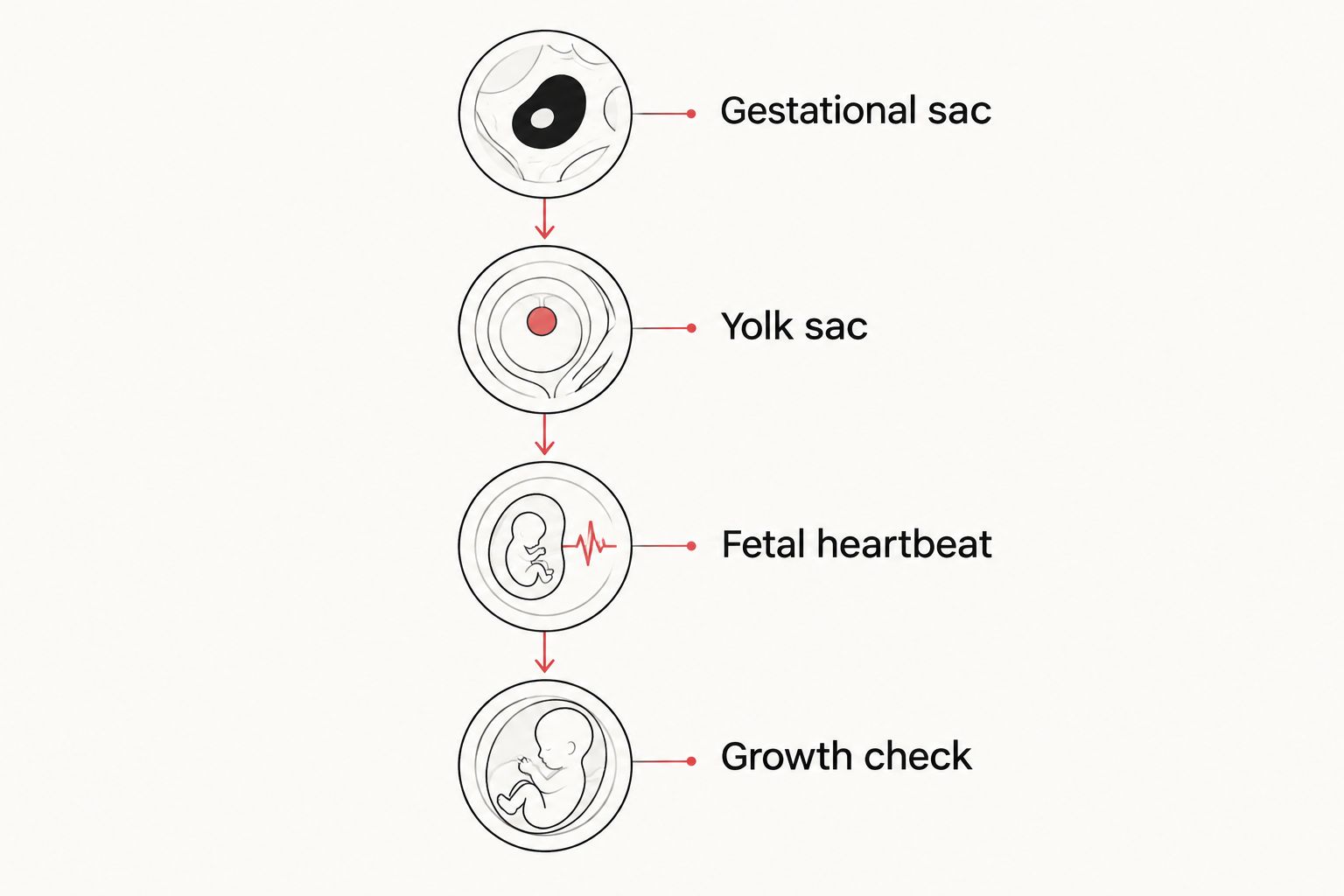
- A gestational sac is typically visible by 5 weeks transvaginally; a heartbeat usually shows by 6 to 7 weeks.
- Two-embryo or split-blastocyst transfers carry a higher multiples risk, so the first scan should count sacs, not just confirm a pregnancy.
- The Ultrasound Concierge runs private early pregnancy ultrasound in Keller and Willow Park, TX, timed to your fertility clinic's protocol.
- Best for IVF patients who want a calm, unhurried early scan matched to their transfer date: The Ultrasound Concierge.
Why early pregnancy ultrasound matters for IVF patients
IVF changes what an early ultrasound needs to answer. A spontaneous pregnancy is dated from an estimate; an IVF pregnancy is dated from a known transfer day, so the scan window can be calculated precisely instead of guessed. That precision matters because a scan booked a week too early produces an inconclusive result that reads as bad news when it isn't.
Fertility clinics also monitor beta hCG closely before handing a patient off to imaging, and that data should travel with the patient to the ultrasound. Multi-embryo transfers add another layer: the first scan isn't just confirming a pregnancy exists, it's counting sacs. The Ultrasound Concierge sees this segment specifically because private early pregnancy ultrasound lets IVF patients get scanned on their protocol's timeline instead of waiting for a hospital imaging slot.
The single most useful fact for IVF patients: your scan date should come from your transfer date, not a due-date calculator built for natural conception.
Confirm your transfer date and calculate your scan window
Get this math right before you book anything — it prevents the single most common scheduling mistake IVF patients make.
- Day-5 blastocyst transfer: add 5 days of embryo age when counting gestational weeks.
- Day-3 transfer: add 3 days instead.
- Frozen embryo transfer (FET) follows the same dating rule as a fresh transfer.
- Ask your fertility clinic for "gestational age as of transfer date," not a generic due-date estimate.
- Confirm whether your clinic's protocol calls for the first scan at day 14, day 21, or later post-transfer.
Schedule your first scan at the right week
Start with what's already available to you before booking anywhere new.
- Ask your fertility clinic if an early viability scan is included in your monitoring package.
- If your clinic releases patients before that scan, book with an OB or a private ultrasound provider directly.
- A scan under 5 weeks risks a "too early to tell" result and a repeat visit.
- A scan around 6 to 7 weeks usually catches sac count and heart activity in one appointment.
- Early pregnancy ultrasound clinics near Fort Worth can often schedule faster than a hospital imaging department.
- Bring your transfer date and recent beta hCG results to whatever appointment you book.
Track beta hCG trends before the ultrasound
- A healthy early pregnancy typically shows beta hCG roughly doubling every 48 to 72 hours.
- Flat or slow-rising trends are a reason to move the scan earlier, not later — flag it to your clinic first.
- Ask your clinic to share prior beta results with whoever performs the ultrasound.
- Don't judge one beta number in isolation; the trend across two or three draws tells the real story.
Prepare for a transvaginal exam
- At 5 to 7 weeks, a transvaginal probe gives clearer images than an abdominal one.
- Empty your bladder before a transvaginal scan — the opposite of the full-bladder rule for abdominal ultrasounds.
- Wear something easy to remove from the waist down.
- Ask in advance whether the visit includes both an abdominal and transvaginal view.
- Bring a support person if the provider allows it; IVF appointments carry more emotional weight than a routine scan.
Watch for multiples and asymmetric growth
- Multi-embryo transfers, and occasionally a single blastocyst that splits, can result in twins.
- The first scan should explicitly count gestational sacs and yolk sacs, not just confirm "a pregnancy."
- Ask the sonographer to note chorionicity and amnionicity if two sacs are found — it changes your monitoring schedule.
- A "vanishing twin," where a second sac stops developing, is a known and documented outcome in early multiples and isn't cause for alarm on its own.
- Providers experienced with this population, like ultrasound studios for twin pregnancies, flag these details at the first visit instead of the second.
Plan your follow-up scan cadence
- Most fertility clinics schedule a second scan 1 to 2 weeks after the first to confirm growth and a stable heart rate.
- After two consecutive scans showing expected growth, many clinics release patients to routine OB care around 8 to 10 weeks.
- Ask before the first scan how many follow-ups your protocol includes.
- Keep every scan report — your OB will want the dating and findings when care transfers over.
Where to get scanned: comparing your options
| Option | Best for | Key limitation |
|---|---|---|
| Fertility clinic in-house monitoring | Patients still mid-protocol with the same clinic | Scan windows tied to clinic schedule, not patient convenience |
| Hospital-based OB ultrasound | Patients past 8 weeks needing full anatomy context | Often books weeks out; longer clinical wait times |
| Private concierge ultrasound studio (The Ultrasound Concierge) | IVF patients wanting a fast, private early scan matched to transfer date | Not a substitute for clinical follow-up if a problem is found |
| Standalone imaging center (e.g., Touchstone Imaging) | Patients needing a general diagnostic order fulfilled | Less likely to specialize in IVF-specific dating and multiples counting |
Verdict: for the first scan after a positive beta, a provider that dates from your transfer date and checks sac count in one visit beats a generic walk-in imaging slot every time.
Common mistakes IVF patients make
- Dating from LMP instead of transfer date — throws scan timing off by a week or more and causes needless "too early" results.
- Booking the first scan too early — before a heartbeat is expected, then reading "not visible yet" as bad news instead of normal timing.
- Skipping the beta hCG trend check — going straight to imaging without confirming whether numbers were rising normally first.
- Assuming every scan needs a full bladder — showing up uncomfortable for what's actually a transvaginal exam.
- Picking the closest imaging center by default — without asking if the sonographer routinely handles IVF patients and multiples counting.
Book your early pregnancy scan
Private early ultrasound in Keller and Willow Park, TX, timed to your transfer date.
FAQ
What's the earliest week an IVF pregnancy can be seen on ultrasound?
A gestational sac is typically visible by around 5 weeks gestational age, dated from the transfer date and viewed with a transvaginal probe. Scanning earlier than that often produces an inconclusive result rather than a clear finding.
Is a transvaginal ultrasound painful for IVF patients?
No, a transvaginal ultrasound is generally described as pressure rather than pain and takes a few minutes. It requires an empty bladder, unlike an abdominal scan.
How is gestational age calculated after IVF?
Gestational age is calculated from the embryo transfer date plus the embryo's age at transfer (typically 3 or 5 days), not from the last menstrual period. This is why IVF pregnancies can be dated more precisely than spontaneous ones.
When should I expect to see a heartbeat after an IVF transfer?
Most viable IVF pregnancies show a visible heartbeat by 6 to 7 weeks gestational age on a transvaginal scan. If it's not visible at that point, a follow-up scan a week or two later is standard practice, not automatically a bad sign.
Do IVF patients need more early ultrasounds than natural pregnancies?
Often yes, because fertility clinics typically schedule one or two monitoring scans before releasing a patient to routine OB care. Natural pregnancies usually skip this early monitoring phase entirely.
Can an early ultrasound confirm twins from IVF?
Yes, the first scan after a positive beta should explicitly count gestational sacs and yolk sacs. This is especially relevant after a multi-embryo transfer or when a single blastocyst splits.
Should I bring my beta hCG results to the ultrasound appointment?
Yes, sharing beta hCG trend data with the ultrasound provider helps interpret the scan, especially if numbers were rising slowly. A single beta value in isolation doesn't tell the sonographer much.
Does The Ultrasound Concierge perform early IVF pregnancy scans?
Yes, The Ultrasound Concierge offers private early pregnancy ultrasound in Keller and Willow Park, TX, and can time the appointment to your transfer date and clinic protocol.
One last thing
A second sac that stops developing early — a vanishing twin — is a documented, well-recognized outcome in IVF multiples and isn't a sign anything was done wrong. If your first scan shows two sacs and a follow-up shows one, that's a known pattern, not a rare failure, and it's worth asking your provider to explain it plainly rather than assuming the worst in 2026's fertility monitoring standards.